What Does Action Mean on a Fishing Rod Beginners Guide
Rod action describes how much and where a fishing rod bends under pressure. It directly affects casting distance, sensitivity, and hook-setting power. This guide breaks down fast, medium, and slow action rods so you can pick the perfect one for your fishing style.
If you have ever walked into a tackle shop or browsed online for a new fishing rod, you have probably seen the word “action” printed right on the handle or spec sheet. It sounds simple enough, but many beginners overlook this one detail and end up with a rod that does not match their fishing style. Understanding what action means on a fishing rod is one of the most important steps you can take toward becoming a better angler.
Rod action influences everything from how far you can cast to how well you feel a subtle bite. It determines how the rod loads during a cast and how much power you have when setting the hook. In this guide, we will break down exactly what rod action is, the different types, and how to choose the right one for your needs. By the end, you will feel confident picking the perfect rod for any fishing situation.
Key Takeaways
- Rod action refers to where and how much a fishing rod flexes when pressure is applied to the tip.
- Fast action rods bend only in the top third, offering greater sensitivity and stronger hook sets.
- Medium action rods bend through the top half, providing a balanced mix of power and flexibility.
- Slow action rods bend throughout most of the blank, making them ideal for light lures and small fish.
- The right action depends on your fishing technique, target species, and lure weight.
- Pairing rod action with the correct line weight and lure size dramatically improves your success on the water.
- Understanding action helps you make smarter gear choices and become a more confident angler.
📑 Table of Contents
- What Does Action Mean on a Fishing Rod?
- The Three Main Types of Rod Action
- How Rod Action Affects Your Fishing Performance
- How to Choose the Right Rod Action for Your Fishing Style
- Rod Action vs. Rod Power: Understanding the Difference
- Common Mistakes When Choosing Rod Action
- Quick Tips for Getting the Most Out of Your Rod Action
- Frequently Asked Questions About Rod Action
- Final Thoughts on Understanding Rod Action
What Does Action Mean on a Fishing Rod?
Rod action describes the point along the rod blank where it begins to flex or bend when pressure is applied to the tip. Think of it as the rod’s “flex profile.” When you press down on the tip or a fish pulls on the line, the rod bends. The location and extent of that bend define the rod’s action.
This is different from rod power, which refers to how much force it takes to bend the rod. Power is about stiffness and strength. Action is about where the bend happens. Many beginners confuse the two, but they are separate characteristics that work together to define how a rod performs.
For example, you can have a heavy-power rod with fast action and a heavy-power rod with moderate action. Both are strong enough to handle big fish, but they will feel completely different in your hands. The fast action rod will be more sensitive and responsive, while the moderate action rod will be more forgiving and flexible.
Understanding this distinction is the first step toward making smarter gear choices. Once you know how action works, you can match it to your fishing technique, target species, and personal preference.
The Three Main Types of Rod Action
There are three primary categories of rod action: fast, medium (also called moderate), and slow. Each one has distinct characteristics that make it better suited for certain fishing styles. Let us take a close look at each type.
Fast Action Rods
A fast action rod bends only in the top third (or top quarter) of the blank. The lower two-thirds remain relatively stiff and rigid. This design gives you excellent sensitivity because the stiff section transmits vibrations from the line directly to your hand.
Fast action rods are popular among anglers who need to feel subtle bites and set hooks quickly. They work especially well with single-hook lures like jigs, soft plastics, and Texas rigs. The stiff backbone provides strong hook-setting power, which is critical when fishing in heavy cover or targeting species with hard mouths.
Here are the key benefits of fast action rods:
- Superior sensitivity for detecting light bites
- Strong hook-setting power thanks to the stiff backbone
- Better accuracy for short to medium casts
- Excellent for fishing in heavy cover where you need to pull fish out quickly
- Ideal for techniques that require quick reaction times
The downside is that fast action rods are less forgiving. If you jerk too hard during a hook set, you can tear the hook free from the fish’s mouth. They also require more precise timing, which can be challenging for beginners who are still developing their technique.
Medium Action Rods
A medium action rod (sometimes called moderate-fast or moderate) bends through the top half of the blank. This gives you a nice balance between sensitivity and flexibility. You still get decent feel, but the rod is more forgiving during the fight.
Medium action rods are incredibly versatile. They handle a wide range of lure weights and fishing techniques, which makes them a great choice for anglers who like to switch things up. If you only want to own one rod, a medium action is often the safest bet.
Here is why many anglers love medium action rods:
- Good balance of sensitivity and flexibility
- More forgiving during hook sets and fights
- Handles a wider range of lure weights
- Great for treble-hook lures like crankbaits and topwater baits
- Suitable for both beginners and experienced anglers
The trade-off is that you sacrifice some sensitivity compared to a fast action rod. You may not feel the lightest bites as clearly. But for all-around fishing, medium action is hard to beat.
Slow Action Rods
A slow action rod bends throughout most of the blank, sometimes all the way down to the handle. This creates a deep, parabolic flex that absorbs shock and keeps fish hooked during long fights. Slow action rods are the most forgiving of all.
These rods shine when you are using light line and small lures. They are classic choices for trout fishing, panfish, and other small species. The full flex protects light tiptops from breaking when a fish surges, and it makes fighting small fish feel much more exciting.
Key advantages of slow action rods include:
- Maximum shock absorption to prevent line breaks
- Protects light line and small hooks from tearing free
- Creates a fun, sporty fight even with small fish
- Excellent for delicate presentations with tiny lures
- Very forgiving for beginners learning to fight fish
The main drawback is reduced sensitivity and hook-setting power. Because the rod absorbs so much energy, it can be harder to drive a hook home at long distances. Slow action rods also require wider open spaces for casting since the flex pattern is less efficient for short, accurate casts.
How Rod Action Affects Your Fishing Performance
Now that you know the three types, let us explore how action actually impacts your day-to-day fishing. The differences are not just theoretical. They change how you cast, detect bites, set hooks, and land fish.
Casting Distance and Accuracy
Rod action plays a major role in how your lure travels through the air. Fast action rods load quickly and release energy in a short, powerful burst. This makes them great for accurate casts at short to medium distances. However, they require good timing to achieve maximum distance.
Medium action rods load a bit deeper and offer a smoother casting motion. They are easier to cast with because the flex helps load the rod naturally. This makes them a solid choice for beginners who are still working on their casting form.
Slow action rods load deeply and release energy over a longer period. They can cast light lures surprisingly far because the full flex acts like a slingshot. But they are less accurate at close range and require more open space to work properly.
Sensitivity and Bite Detection
If you have ever fished with a slow action rod and then switched to a fast action, the difference in feel is dramatic. Fast action rods transmit vibrations from the line directly to your hand through the stiff lower section. You can feel every bump, tap, and nibble.
Medium action rods still offer decent sensitivity, but some of the vibration is absorbed by the flexing mid-section. For most fishing situations, this is perfectly adequate. You will still feel bites clearly, especially with larger or more aggressive fish.
Slow action rods absorb the most vibration. This makes it harder to detect subtle bites, especially in deep water or when using light lures. Anglers who fish slow action rods often rely more on watching their line for movement rather than feeling the bite through the rod.
Hook Setting Power
Setting the hook is where rod action really matters. A fast action rod delivers a quick, powerful hook set because the stiff backbone transfers energy efficiently. This is critical when fishing with single-hook presentations like jigs or worms, where you need to drive the hook through plastic and into the fish’s mouth.
A medium action rod provides a solid hook set with a bit more flex. This is actually an advantage when using treble-hook lures like crankbaits. The flex keeps the fish from pulling the hooks free during the fight.
A slow action rod absorbs a lot of the hook-setting energy. You need to use a sweeping motion rather than a sharp jerk to drive the hook home. This works fine for small fish with light hooks, but it is not ideal for big fish or heavy cover.
Fish Fighting and Landing
During the fight, rod action determines how the rod absorbs a fish’s runs and headshakes. Slow action rods excel here because the deep flex acts like a shock absorber. The rod bends continuously, keeping constant pressure on the fish and preventing the line from snapping.
Fast action rods are less forgiving during the fight. If a fish makes a sudden run, the stiff lower section does not absorb much shock. This means you need to rely more on your drag system and proper rod angle to prevent break-offs.
Medium action rods offer a nice middle ground. They absorb some shock while still giving you enough backbone to steer fish away from structure.
How to Choose the Right Rod Action for Your Fishing Style
Choosing the right rod action comes down to three main factors: the species you are targeting, the lures or baits you prefer, and your experience level. Here is a practical breakdown to help you decide.
Match Action to Your Target Species
Different fish require different approaches. Here is a quick guide:
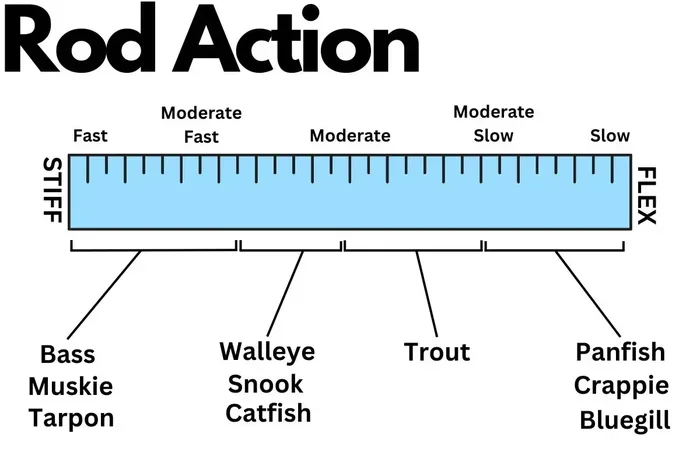
- Bass fishing: Fast action for jigs, Texas rigs, and heavy cover. Medium action for crankbaits, spinnerbaits, and topwater.
- Trout fishing: Slow to medium action for light lures and small streams. Fast action for larger rivers and heavier presentations.
- Panfish: Slow action for the most fun and best protection of light line.
- Saltwater inshore: Medium to fast action for redfish, snook, and speckled trout. Check out these saltwater fishing tips for more species-specific advice.
- Pike and musky: Fast action for strong hook sets and control over powerful fish.
Match Action to Your Lure Type
The lure you use is just as important as the fish you are chasing. Single-hook lures like jigs, worms, and swimbaits work best with fast action rods because you need that quick, powerful hook set.
Treble-hook lures like crankbaits, jerkbaits, and topwater plugs pair well with medium action rods. The flex keeps the fish from throwing the hooks during the fight.
Tiny lures like small spinners, flies, and micro jigs are best fished on slow action rods because the deep flex loads easily even with lightweight offerings.
Consider Your Experience Level
If you are just starting out, a medium action rod is the most forgiving and versatile choice. It handles a wide range of techniques and is more tolerant of mistakes. As you gain experience, you can add fast and slow action rods to your collection for specific situations.
New anglers should also check out this fishing guide for beginners to learn the fundamentals before investing in multiple rods.
Rod Action vs. Rod Power: Understanding the Difference
We touched on this earlier, but it deserves its own section because the confusion between action and power is one of the most common mistakes beginners make.
Rod power refers to the rod’s overall stiffness and lifting strength. It is usually labeled as ultra-light, light, medium-light, medium, medium-heavy, heavy, or extra-heavy. A heavy-power rod takes a lot of force to bend, regardless of where it bends.
Rod action refers to where the bend occurs. A fast action heavy rod bends only at the tip but is very stiff overall. A slow action heavy rod bends throughout but still has strong lifting power.
Here is a simple comparison table:
| Feature | Rod Action | Rod Power |
|---|---|---|
| Definition | Where the rod bends | How much force it takes to bend |
| Measured by | Flex point along the blank | Stiffness and lifting strength |
| Common labels | Fast, Medium, Slow | Light, Medium, Heavy |
| Affects | Sensitivity, hook set, casting | Fish-fighting power, lure weight range |
The best rods are designed with both action and power in mind. When shopping, look for both specifications and think about how they work together. A medium-heavy, fast action rod is a popular choice for bass fishing because it offers strong hook-setting power with good sensitivity.
Common Mistakes When Choosing Rod Action
Even experienced anglers sometimes pick the wrong action for the job. Here are the most common mistakes to avoid:
Using Fast Action for Treble-Hook Lures
If you throw crankbaits on a fast action rod, you will likely pull hooks. The stiff tip does not give the fish any room to surge, and the treble hooks can tear free. Switch to medium action for treble-hook baits.
Using Slow Action for Heavy Cover
Fishing in thick weeds or around structure requires a strong hook set and the power to pull fish out. A slow action rod will struggle here. The deep flex absorbs too much energy, and you will lose fish in the cover.
Ignoring Line and Lure Weight Ratings
Every rod has a recommended line weight and lure weight range printed on the blank. These ratings are designed to work with the rod’s action. Using line or lures outside the recommended range will hurt performance and could damage the rod.
Choosing Based on Looks Alone
A rod might look great on the shelf, but if the action does not match your fishing style, it will not perform well. Always check the action rating before buying. If you are unsure, ask a knowledgeable staff member at your local tackle shop.
Not Testing Before Buying
If possible, hold the rod and flex it before purchasing. Many tackle shops have demo rods you can try. Feeling the flex pattern in person is worth more than reading any spec sheet.
Quick Tips for Getting the Most Out of Your Rod Action
Once you have the right rod, these tips will help you maximize its performance:
- Match your reel and line to the rod’s specifications. A mismatched setup will negate the benefits of the correct action.
- Adjust your hook set technique based on action. Use a sharp, quick snap for fast action. Use a smooth sweep for slow action.
- Keep your rod tip up during the fight to maintain consistent pressure and take advantage of the rod’s flex.
- Practice casting with different lure weights to learn how your rod loads and releases energy.
- Store your rods properly to maintain their action over time. Avoid leaning them against walls at sharp angles.
- Learn proper rod grip for better control. If you are unsure, this guide on how to hold a fishing rod is a great resource.
Frequently Asked Questions About Rod Action
What is the best rod action for beginners?
A medium action rod is the best choice for beginners. It offers a good balance of sensitivity and forgiveness, handles a wide range of lure weights, and works well for many different fishing techniques. As you gain experience, you can experiment with fast and slow action rods for specific situations.
Visual guide about fishing rod action
Image source: begintofish.com
Visual guide about fishing rod action
Image source: calloutdoors.com
Visual guide about fishing rod action
Image source: allfishinggear.com
Does rod action affect casting distance?
Yes, rod action directly affects casting distance. Fast action rods are great for accurate, short-to-medium casts. Slow action rods can cast light lures surprisingly far due to their deep flex. Medium action rods offer a good compromise between distance and accuracy.
Can I use any lure with any rod action?
Technically you can, but you will not get the best results. Single-hook lures work best with fast action, treble-hook lures pair well with medium action, and tiny lures perform best on slow action rods. Matching lure type to rod action improves hook-up ratios and reduces lost fish.
Is fast action better than slow action?
Neither is universally better. Fast action excels at sensitivity and hook-setting power, making it ideal for single-hook presentations and heavy cover. Slow action is better for light lures, small fish, and situations where shock absorption matters most. The “best” action depends entirely on what you are fishing for and how you like to fish.
How do I know what action my current rod has?
Check the rod blank near the handle. Most manufacturers print the action rating there. If it is not labeled, you can test it by attaching a weight to the tip and observing where it bends. If only the top third flexes, it is fast action. If the top half flexes, it is medium. If it bends throughout, it is slow action.
Does rod action change over time?
Quality rods maintain their action for many years with proper care. However, extreme heat, improper storage, or physical damage can alter a rod’s flex pattern. Store your rods in a cool, dry place and use protective tubes during transport to preserve their original action.
Final Thoughts on Understanding Rod Action
Understanding what action means on a fishing rod is a game-changer for anglers of all skill levels. It is one of those foundational concepts that, once you grasp it, makes every other gear decision easier. You will stop guessing and start choosing rods with confidence.
Remember that fast action gives you sensitivity and power at the tip. Medium action offers versatility and forgiveness. Slow action provides maximum flex and shock absorption. Each type has its place in your tackle collection.
The best way to learn is to get out on the water and experiment. Try different rods, different actions, and different techniques. Pay attention to how each rod feels during the cast, the hook set, and the fight. Over time, you will develop an intuitive sense for which action works best in each situation.
If you are building your first tackle setup, start with a medium action rod and expand from there. And if you want to sharpen your overall skills, check out these best fishing tips every angler should know. The more you learn, the more enjoyable and productive your time on the water will be.
Frequently Asked Questions
What does fast action mean on a fishing rod?
A fast action rod bends only in the top third of the blank when pressure is applied. This design provides excellent sensitivity and strong hook-setting power, making it ideal for single-hook lures like jigs and soft plastics.
What does slow action mean on a fishing rod?
A slow action rod bends throughout most of the blank, creating a deep parabolic flex. This makes it perfect for light lures, small fish, and situations where you need maximum shock absorption to protect light line.
Is medium action good for all-around fishing?
Yes, medium action is considered the most versatile rod action. It balances sensitivity and flexibility, handles a wide range of lure weights, and works well for both beginners and experienced anglers across many fishing techniques.
How does rod action affect hook sets?
Rod action determines how much energy is transferred during a hook set. Fast action rods deliver quick, powerful hook sets. Slow action rods absorb more energy, requiring a wider sweeping motion. Medium action falls somewhere in between.
Can I fish bass with a slow action rod?
You can, but it is not ideal for most bass techniques. Slow action rods lack the hook-setting power needed for single-hook presentations and heavy cover. A fast or medium action rod is a much better choice for bass fishing.
What rod action is best for trout fishing?
For most trout fishing, a slow to medium action rod works best. These rods protect light line, cast small lures effectively, and make fighting trout more enjoyable. In larger rivers with heavier presentations, a fast action rod may be more appropriate.