How To Find A Good Trout Fishing Spot: Expert Tips
Finding a good trout fishing spot starts with learning how trout use water. Trout do not spread out at random. They seek places that offer food, cover, cool water, and protection from strong current. Once you learn to read those clues, a plain-looking stream can reveal deep pools, feeding lanes, and holding water.
You do not need an expensive boat or advanced fly-fishing skills. A beginner with a spinning rod, a few small lures, and a state fishing license can find trout from shore. Experienced anglers can use maps, water temperature, stream flow, and fish behavior to narrow the search even more.
The best trout fishing spot also depends on the species. Rainbow trout often use current seams and riffles. Brown trout favor cover, shadows, and deeper water. Brook trout usually need cold, clean streams with plenty of structure. Stocked trout may stay near access points, hatchery trucks, or easy feeding areas.

Quick answer: Look for cold, oxygen-rich water with food and cover
The best way to find a good trout fishing spot is to search for cold water, steady current, depth changes, food, and nearby cover. Start with public access, then inspect pools, riffles, undercut banks, fallen trees, boulders, and current seams. Fish early or late, check local stocking reports, and adjust your location as water temperature and flow change.

A strong trout spot usually has at least two of these features:
- A deep pool beside faster water
- A current seam where fast and slow water meet
- Shade from trees, banks, or rocks
- An undercut bank
- Submerged logs or large boulders
- A riffle that carries insects and oxygen
- A spring, tributary, or cold-water inlet
- Easy access to food such as insects, minnows, or worms
Do not judge a spot only by its looks. A beautiful bank may hold no fish. A plain bend in the stream may have the best water in the area.
Start with maps, stocking reports, and public access
Finding trout begins before you reach the water. Use maps and official fishery reports to learn where trout live, where anglers can legally fish, and how water conditions may affect the fish.
Look for rivers, streams, creeks, lakes, and reservoirs that support trout year-round or receive seasonal stockings. Your state wildlife agency is often the most useful source. Its website may list stocked waters, stocking dates, access points, special regulations, boat ramps, and catch limits.

Use official stocking information
Stocked trout often stay near release sites for a short time. They may also move into nearby pools, deeper bends, or slow water. If you are new to trout fishing, a recently stocked pond or stream can offer a simple place to learn.
Stocking reports are not a guarantee. Trout may move after heavy rain, warm weather, fishing pressure, or changes in water level. Still, these reports give you a useful starting point.
Check whether the water receives:
- Rainbow trout
- Brown trout
- Brook trout
- Lake trout
- Cutthroat trout
- Golden trout
- Tiger trout or other stocked hybrids
Each species may use different habitat. Lake trout, for example, often need deep, cold water. Brook trout may live in small mountain streams. Stocked rainbow trout may hold in lakes, ponds, and slow river sections.

Read maps before you travel
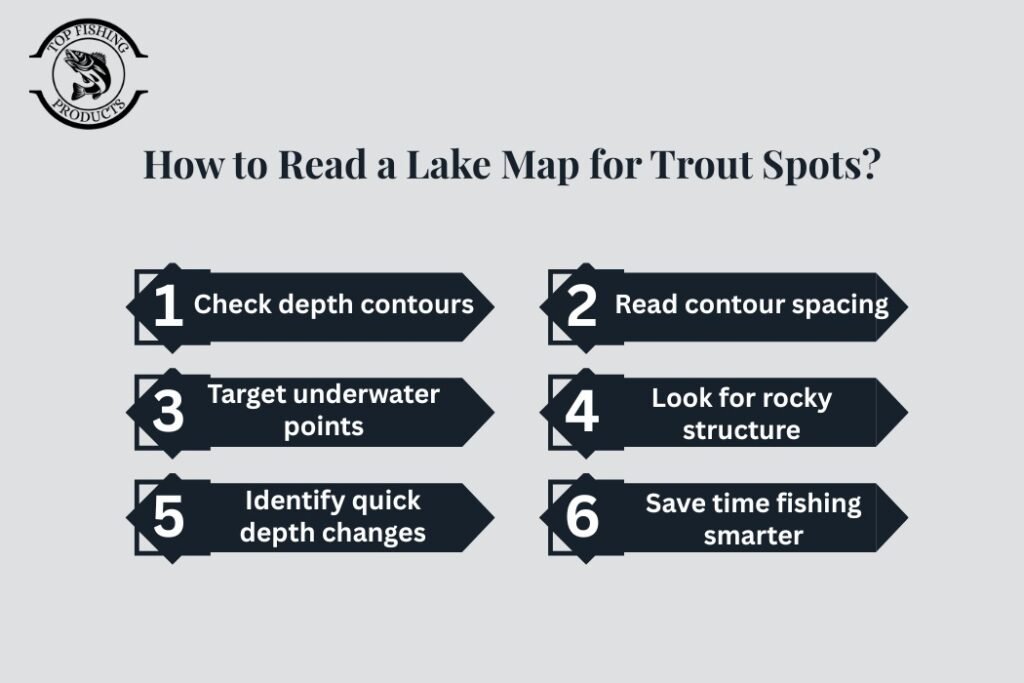
Use a topographic map, satellite map, or state fishing map. A topographic map shows changes in land height. Tight contour lines often point to steep banks, narrow valleys, and deeper stream channels.
Satellite images can show:
- Stream bends
- Gravel bars
- Deep pools
- Bridges
- Access roads
- Beaver ponds
- Tributaries
- Shaded banks
- Fallen timber
- Lake inlets and outlets
Look for places where two habitat types meet. A shallow gravel bar beside a deep pool is often more useful than a long, even stretch of water. A creek entering a larger river may add cold water and food.

Confirm that access is legal
Private land may border a stream even when the water itself looks easy to reach. Do not cross private property without permission. Use public fishing areas, parks, national forests, wildlife areas, and easements that allow fishing.
Some waters allow access only from public road crossings. Others require a parking permit, daily pass, or special access rule. Check signs at the site before unloading your fishing gear.
📜 Check Local Regulations: Confirm your fishing license, trout stamp, open season, bag limit, size limit, bait rules, hook rules, and public access rights with your state or local wildlife agency. Regulations can vary from one stream section to the next.
Match the water to your travel limits
The best trout stream is not useful if it requires a long hike that does not fit your skill level or schedule. Beginners and families may prefer a stocked pond with flat banks. Experienced anglers may enjoy a remote backcountry creek.
| Water type | Good choice for | What to expect |
|---|---|---|
| Stocked pond | Beginners, kids, and gift buyers | Simple access and slower water |
| Small creek | Light-tackle anglers | Tight casting and spooky fish |
| Freestone river | Intermediate and advanced anglers | Riffles, pools, and changing flows |
| Tailwater | Experienced anglers | Cold water and steady flows |
| Mountain lake | Boat or kayak anglers | Deep water and changing weather |
Start with water that matches your safety and travel needs. A close, legal stream that you can fish well is often better than a famous river that leaves you tired before you cast.
Learn how trout use water
Trout need several things at once. They need oxygen, food, safety, and a place where they can hold without using too much energy. The best trout fishing spots combine these needs.
Cold water holds more dissolved oxygen than warm water. Trout also have a narrow comfort range compared with bass, catfish, and many panfish. When water warms, trout may move toward springs, deeper pools, shaded banks, or faster water with more oxygen.

Search for current seams
A current seam is the line where fast water meets slow water. Trout often hold just inside the slower side. Food drifts past in the faster current, while the trout saves energy.
Look for:
- A sharp line between smooth and rough water
- Foam moving along one path
- Leaves or bubbles gathering in a narrow lane
- Slow water behind a rock
- The edge of a riffle
- A pocket beside a fast chute
Cast above the seam and let your bait, lure, or fly move through it. With a spinning setup, use a small spoon, inline spinner, jig, or soft plastic. With a fly rod, try a drift that enters the feeding lane without drag.
“Drag” means the current pulls your line or fly in a way that looks unnatural. A good presentation moves at nearly the same speed as the water around it.
Study pools and pool tails
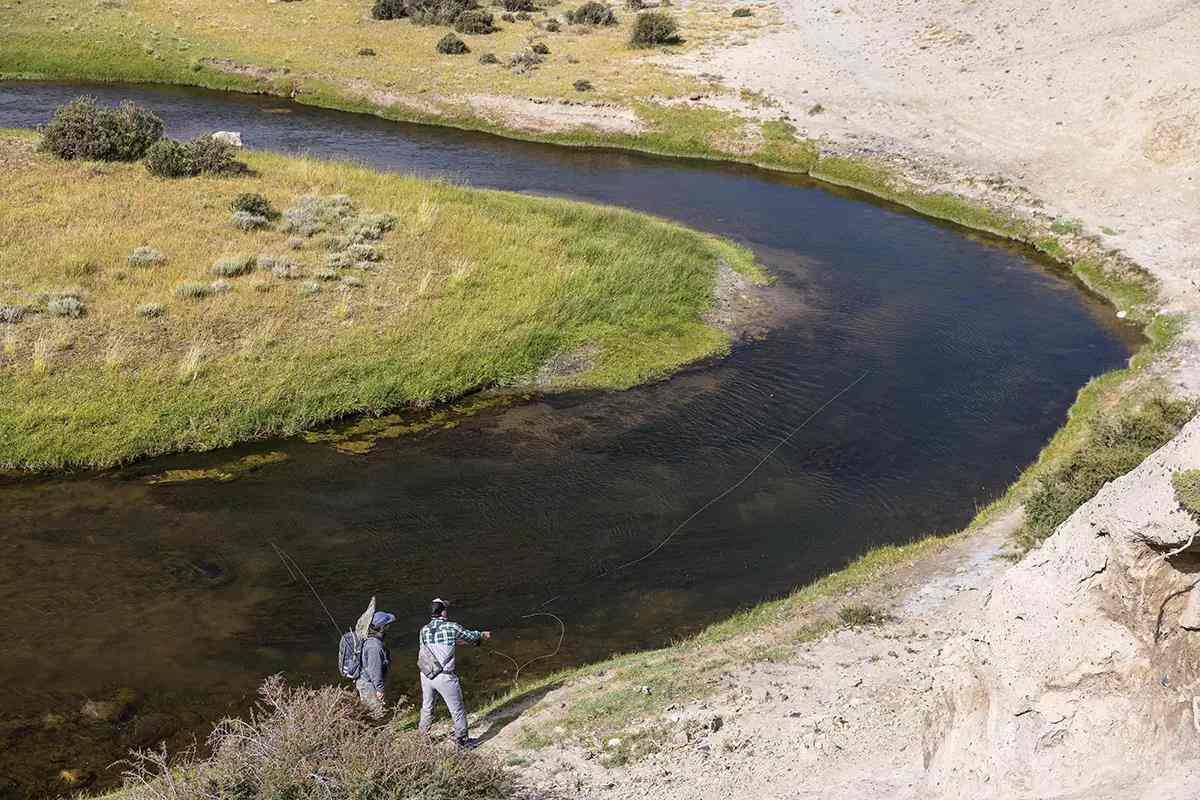
A pool is a deeper section of a river or stream. Trout often rest near the head, middle, or tail of a pool. The best part may change with light, water level, and fishing pressure.
The head of the pool often has fresh oxygen and drifting food. The middle offers depth and security. The tail, where water becomes shallow and fast, can hold trout that feed on insects moving downstream.
Approach the pool from downstream when possible. Trout face into the current, so they are more likely to see you if you walk upstream toward them.

Inspect undercut banks
An undercut bank has a hollow space beneath the edge of the stream. Trout use this space as shade and cover. Brown trout often favor undercut banks, especially during bright daylight.
Do not stomp along the bank. Keep a low profile, stay several feet back, and cast from a distance. One accurate cast near the bank can be better than many casts that land in the middle.
Undercut banks can collapse. Keep away from unstable edges, especially after rain or high water.
Find rocks, logs, and deep cover
Large rocks break the current and create a resting place behind them. Fallen trees provide shade and cover. Bridge pilings, root wads, and submerged branches can also attract trout.
Fish the downstream side of cover first. Trout often face into the current and watch food pass by. Then work the sides and front if the water remains clear.
Cover also creates a challenge. Hooks can snag wood and rocks. Use a lure or rig that fits the area. A single hook, light jig, or floating bait may be easier to free than a treble-hook crankbait.

Watch riffles and runs
A riffle is shallow, broken water that flows over rocks. A run is a deeper stretch with steady current. These areas carry oxygen and insects, so trout may use them throughout the day.
Look for the deeper pockets inside a riffle. Trout do not always sit in the strongest current. They often hold behind rocks, along the edge, or in a small depression.
Early in the day, trout may move into shallow runs to feed. As sunlight increases, they may slide toward deeper water or nearby cover.
Know how water temperature and flow change a spot
Water conditions can move trout more than the name of a stream. A spot that works in spring may be poor in midsummer. Heavy rain can turn a clear creek brown and push trout into softer water.
A small stream thermometer can help. Measure the water in the shade. Avoid standing in the stream longer than needed, especially during warm weather or spawning periods.

Use temperature as a guide
Cold-water trout need protection when conditions become warm. Exact limits vary by species, region, and water source, but many anglers become cautious when stream temperatures rise into the upper 60s Fahrenheit.
Warm water increases stress during catch and release. Trout may need more time to recover after a fight. If the water is unusually warm, consider fishing for another species or stopping for the day.
| Water condition | Likely trout location | Fishing response |
|---|---|---|
| Cold and clear | Riffles, seams, pools, and cover | Use careful approaches |
| Cold and high | Banks, eddies, and slower pockets | Fish protected water |
| Warm and low | Springs, deep pools, and shaded areas | Limit handling and fishing time |
| Rising after rain | Banks, soft edges, and tributary mouths | Use visible bait or lures |
| Falling and clearing | Pools, seams, and feeding lanes | Spread out and cover water |
The key is not one exact number. Watch the trend. A stream that rises from 58°F to 64°F may fish differently from one that falls from 70°F to 64°F.

Understand high and low flows
High water gives trout more cover but makes current stronger. Fish may leave the middle of the stream and move close to banks, rocks, eddies, and flooded grass.
Low water makes trout easier to see but also makes them cautious. Clear, low water calls for smaller tackle, longer casts, lighter line, and quiet steps.
After a moderate rise, food may wash into the stream. Trout can feed well when the water begins to clear. After a major flood, safety comes first. Fast water can sweep away anglers, and banks may be unstable.
⚠️ Safety Warning: Never wade high or fast water just to reach a promising spot. Wear a properly fitted personal flotation device near deep water, boats, and kayaks. Tell someone your plan, check the weather, and turn back when water becomes unsafe.
Choose trout habitat by season
Trout locations change with weather, insect activity, water temperature, and spawning behavior. The same river can offer different choices in spring, summer, fall, and winter.

| Season | Common trout pattern | Areas to check |
|---|---|---|
| Spring | Feeding after runoff and insect activity | Riffles, runs, and pool edges |
| Summer | Seeking cold water and shade | Springs, deep pools, and shaded banks |
| Fall | Feeding and spawning movement | Tributaries, gravel beds, and deeper runs |
| Winter | Conserving energy | Slow pools and deep, stable water |
Spring water can be cold and high. Trout may hold near banks, eddies, and slower seams. As insect hatches grow, riffles and shallow runs may become active feeding areas.
Summer requires more care. Fish early and late when light is low. Search for spring-fed water, shaded pools, and deep sections. Avoid stressing trout in warm water.
Fall can bring strong feeding before winter. Brown trout may become more active, but spawning fish need special care. Do not step on clean gravel beds or disturb fish that are actively spawning.
Winter trout often prefer slow, deep water. They may feed less often, so a patient presentation can matter more than covering a large area.
Use signs of food to locate trout
Food tells you where trout may spend time. Insects, minnows, worms, crayfish, and small fish all use certain parts of a stream. Trout follow those food sources.
Look under rocks along the bank. You may find mayfly nymphs, caddisfly larvae, stonefly nymphs, or other aquatic insects. Watch the surface for rising trout, floating insects, or small dimples.

Check the water’s food conveyor belt
Current carries food downstream like a moving belt. Trout often face into that belt from a protected position. A rock, log, seam, or deep edge lets them feed without fighting the full current.
When you see foam, leaves, or bubbles moving along one path, study the water below it. That path may also carry insects. Cast upstream and allow your bait or lure to enter the drift.
Look for minnows and crayfish
Small minnows may gather near rocky banks, bridge areas, and tributary mouths. Trout may follow them into deeper pools or current edges.
Crayfish favor rocky bottoms and slower water. In lakes and reservoirs, trout may use points, drop-offs, and rocky shorelines when crayfish or baitfish are active.
A small spoon, minnow-style plug, jig, or soft plastic can imitate these food sources. Match the lure size to the bait you see. A 1/16- to 1/8-ounce lure is often easier to cast on light spinning gear than a large bass lure.

Watch birds and surface activity
Birds can reveal baitfish and insect activity. Swallows may feed over a hatch. Herons may stand near shallow edges. Diving birds may point to baitfish in a lake.
Birds do not always indicate trout. They may be feeding on another species. Use their activity as one clue, then confirm the water depth, temperature, cover, and current.
Pick gear that helps you search efficiently
The right gear does not replace good water reading, but it helps you test a spot without wasting time. Trout gear should match the size of the fish, the water, and the cover.
For many beginners, a 6- to 7-foot ultralight or light spinning rod is a practical choice. A 1000- to 2500-size spinning reel with a smooth drag pairs well with 2- to 6-pound monofilament or a light braided main line with a fluorocarbon leader.
“Power” describes how much force a rod needs to bend. “Action” describes where it bends. A fast-action rod bends near the tip. A moderate-action rod bends farther down the blank.
| Trout fishing situation | Rod and reel setup | Line and terminal tackle |
|---|---|---|
| Small creek | 5'6"–6'6" ultralight spinning rod | 2–4 lb mono, size 8–14 hook |
| Stocked pond | 6'–7' light spinning rod | 4–6 lb mono, small bobber or spinner |
| Large river | 7' light or medium-light spinning rod | 6–10 lb line, 1/16–1/8 oz lures |
| Fly fishing | 8'–9' 3–5 weight fly rod | Matching fly line and tapered leader |
A spinning reel is usually easiest for beginners and kids. A spincast combo is even simpler for young anglers, but it may not cast tiny lures as well. A baitcaster can offer control for larger lures, yet it takes practice and can develop backlash, which is a tangled spool caused by the spool turning faster than the line leaves it.
Fly rods work well when trout feed on insects or when you need a delicate drift. Telescopic rods save space for hiking, but low-cost models may have weaker guides or shorter service life. Ice fishing rods suit frozen lakes, not moving-water trout in summer.
Pack tools that support safe handling
A small tackle box should hold:
- Small spinners and spoons
- Jigs
- Soft plastics
- Bobbers
- Split-shot sinkers
- Swivels
- Hooks from size 8 to 14
- Fluorocarbon leaders
- Monofilament line
- Line cutters
- Needle-nose pliers
- A small landing net
- A tape measure
- A thermometer
Polarized sunglasses reduce surface glare and help you see rocks, drop-offs, and fish. They also protect your eyes from hooks. Wear a hat and apply sunscreen, even on cool days.
Use the right bait and lure
Live bait can help beginners cover water with little casting skill. Worms, minnows, and insects may work where regulations allow them. Some waters ban live bait to protect wild trout or prevent the spread of invasive species.
Artificial lures are easy to carry and allow you to search faster. Small inline spinners, spoons, jigs, soft plastics, and floating crankbaits can all have a place.
For catch and release, consider barbless single hooks where legal. Barbed hooks are easier to hold in a fish, while barbless hooks often make release faster. Always follow local rules.
👪 Parent or Gift-Buyer Note: For a child, choose a simple spincast combo, a small tackle box, forceps, polarized sunglasses, and a life jacket. Avoid gifting sharp hooks without adult supervision and a safe storage plan.
Approach the bank without spooking trout
Trout have strong eyesight and feel vibration through the water. Poor movement can ruin a good spot before your first cast.
Walk softly. Keep your shadow off the water when possible. Wear muted clothing that blends with the bank. Crouch near clear, shallow water, and avoid standing on the edge.
Fish from downstream to upstream
Approaching from downstream often keeps you behind trout that face into the current. Start with the nearest water. Then work toward the far bank and the head of the pool.
This approach also lets you fish one section at a time. Do not walk past water that could hold fish. A small pocket behind your feet may contain a trout you would never see from the road.
Cast to the highest-value water first
Your first cast should target the best feature, not the empty middle of the stream. Aim for:
- The head of a pool
- A current seam
- The downstream side of a rock
- An undercut bank
- A shaded log or root
- The tail of a pool
- The edge of a riffle
Use a short cast first. A long cast creates more line on the water and more chances for poor presentation. Increase distance only when nearby water is covered.
Cover water in a planned way
Fan your casts across the likely holding area. Change the angle by a small amount each time. After several casts, move a few steps and repeat.
Do not stay in one place for an hour without changing something. Change the depth, speed, lure, angle, or location. If trout follow but do not strike, slow the lure or use a smaller presentation.
Experienced anglers may use a fish finder on a boat or kayak to locate depth changes. A fish finder shows structure and, in some cases, fish marks. It does not replace knowledge of trout habitat or local regulations.
Compare trout spots by angler type
One location cannot serve every angler. The right spot depends on skill, mobility, safety, and the species you want to catch.
| Angler | Suitable trout spot | Why it works |
|---|---|---|
| Beginner | Stocked pond or easy-access stream | Simple casting and safe footing |
| Child or family | Flat bank with slow water | Easier supervision and fewer hazards |
| Fly angler | Riffle, run, or pool with insect life | Supports drifting flies |
| Spin angler | Pool, seam, or rocky bank | Allows active lure searching |
| Advanced angler | Remote tributary or technical tailwater | Rewards careful reading and presentation |
| Kayak angler | Lake point, inlet, or calm reservoir arm | Covers more water with boat access |
A beginner should avoid starting in a deep, fast river. An experienced angler may find that same river rewarding, but only with proper wading skills and safety gear.
A gift buyer should focus on access and simplicity. A young angler may enjoy a stocked pond more than a remote stream that requires a long hike.
Recognize productive lake and reservoir spots
Not all trout fishing happens in streams. Lakes and reservoirs can offer strong trout habitat near inlets, outlets, points, drop-offs, and submerged channels.
Cold-water trout often move deeper as surface water warms. In spring and fall, they may feed near shore. In summer, boat anglers may need downriggers, weighted lines, or a fish finder to reach the right depth.
Search lake inlets and outlets
An inlet brings water, food, and oxygen into a lake. Trout may gather where the inlet current meets the lake. The outlet can also attract fish, but access and regulations vary.
Fish the edges of moving water first. Trout may sit just outside the strongest flow. Do not stand in or near dangerous spillways.
Study points and drop-offs
A point is land that extends into the lake. A drop-off is a quick change from shallow to deep water. These features give trout a travel route and access to different temperatures.
Cast along the edge of the drop-off. Trolling anglers may follow the contour with spoons or small crankbaits. Shore anglers can work parallel to the bank and vary the retrieve speed.
Use a kayak with care
Kayak fishing can help you reach shorelines and coves that are hard to access on foot. It also adds risk. Wear a U.S. Coast Guard–approved PFD at all times. Secure rods, pliers, hooks, and landing nets so they do not become loose hazards.
Check wind, storms, boat traffic, water temperature, and your kayak’s weight capacity. Take a boating safety course if you are new to kayak fishing.
Avoid common mistakes when choosing a spot
Many anglers lose time because they search only for famous locations or fish the easiest water without studying it. Small changes in method can improve your day.
| Mistake | Why it hurts | Better choice |
|---|---|---|
| Fishing only the deepest pool | Trout also use seams and shallow feeding water | Cover depth changes |
| Walking loudly | Vibration can alert trout | Move slowly and stay back |
| Using heavy line | It can reduce natural lure movement | Match line to fish and cover |
| Fishing warm water too long | Trout may suffer during release | Stop or target another species |
| Ignoring regulations | Rules protect fish and anglers | Check current agency guidance |
| Staying in one spot | Fish may be elsewhere | Cover several likely features |
Do not assume bigger water means better fishing. Small creeks can hold wild trout, while large rivers may have difficult access or heavy pressure.
Do not wade through every promising area. Wading can destroy insect habitat, disturb spawning beds, and muddy the water. Fish from shore when possible.
🔧 Quick Fix: If a spot looks good but produces no action, change one factor at a time. Try a smaller hook, a lighter leader, a slower retrieve, a different depth, or a cast from a new angle.
Follow conservation and fish-handling practices
Good trout fishing protects the fishery. Wild trout grow slowly in many waters, and warm conditions can make release stressful.
Handle trout with wet hands
Wet your hands before touching a trout. Keep the fish in the water whenever possible. Avoid squeezing the body or touching the gills.
Use a rubberized landing net when one is needed. A net can reduce handling time and keep a fish from hitting rocks. Remove the hook with forceps or hemostats.
If you take a photo, plan it before lifting the fish. Keep air exposure to a few seconds. Support the fish with both hands, then point it into gentle current until it swims away.
Protect spawning areas
Many trout spawn in clean gravel. Spawning areas may look like bright patches of small stones called redds. Do not walk on them, drag anchors across them, or target actively spawning fish where regulations prohibit it.
Follow special rules for wild trout, artificial lures, fly-only water, barbless hooks, and seasonal closures. These rules protect local fish populations.
🌿 Conservation Note: Pack out old line, bait containers, hooks, and soft plastics. Discard fishing line in a recycling bin or line collection box when available. Never leave line where birds or wildlife can become trapped.
Know when to move to a new trout spot
A good angler does not force a bad location. Move when the water gives you clear reasons.
Change spots when:
- The water temperature is unsafe for trout
- The stream is too high or muddy to fish safely
- You have covered all major features
- Fish are visibly spooking before you cast
- The current has changed
- Other anglers have crowded the area
- You cannot reach the water without unsafe wading
- The available habitat does not match your target species
Give a spot enough time to test it. Five casts may not be enough in deep or stained water. At the same time, do not spend the full day repeating the same cast with no adjustment.
A useful rule is to fish one feature in several ways. Try the top, middle, and bottom of the water column. Change the angle and speed. Then decide whether the spot deserves more time.
Estimate the cost of finding trout water
Finding a good trout spot does not require a large budget. Your main costs may be a license, transportation, bait, and simple tackle.
| Budget level | Useful items | Best for |
|---|---|---|
| Under $50 | License, small lures, hooks, line, pliers | Beginners using an existing rod |
| $50–$150 | Spinning combo, tackle box, net, sunglasses | New anglers and kids |
| $150–$400 | Better rod and reel, waders, thermometer, map tools | Regular stream anglers |
| $400 and more | Fly setup, quality waders, kayak, electronics | Dedicated or advanced anglers |
Current pricing ranges from low-cost starter gear to premium fly and boat equipment. Price alone does not identify a good fishing spot or make a beginner more successful.
Spend first on safety, access, and basic function. A smooth spinning reel, reliable line, polarized sunglasses, and proper footwear may help more than an expensive lure collection.
FAQs about finding trout fishing spots
Q: What is the best time of day to find trout?
A: Early morning and late evening often offer cooler water, lower light, and active feeding. Cloudy days can extend feeding activity. Still, water temperature, flow, insect activity, and fishing pressure matter more than the clock alone.
Q: How do I find trout in a river?
A: Start with current seams, pools, riffles, undercut banks, rocks, logs, and tributary mouths. Trout often hold where they can face current, receive food, and avoid the strongest flow. Approach from downstream and cover nearby water before walking farther.
Q: Are deep pools always the best trout spots?
A: No. Deep pools offer safety, but trout also use shallow riffles, pool tails, current seams, and protected banks. The best area may change with light, water temperature, insect activity, and flow.
Q: What is the best trout fishing spot for beginners?
A: A stocked pond or slow stream with legal public access is often best for beginners. Look for flat ground, clear signs, nearby parking, and a low risk of fast water. These locations make it easier to learn casting and fish handling.
Q: What line should I use for trout?
A: Use 2- to 6-pound monofilament for many small-stream and stocked-trout situations. Fluorocarbon leaders can help in clear water. Braided line works well for casting distance, but pair it with a lighter leader and check local rules.
Q: Should I use bait or lures for trout?
A: Live bait can be simple for beginners, while lures help you search water quickly. Worms, minnows, spinners, spoons, jigs, and soft plastics can all work where legal. Always check bait restrictions before fishing.
Q: Can I find trout with a fish finder?
A: A fish finder can show depth, bottom structure, and possible fish marks in lakes and reservoirs. It does not identify every trout or replace water knowledge. Use it with temperature, maps, seasonal patterns, and safe boating habits.
Q: How do I find wild trout instead of stocked trout?
A: Look for cold, clean tributaries, remote headwaters, spring-fed streams, and habitat with natural cover. State agencies and local trout groups may provide information. Wild trout streams often have special rules, so check regulations before fishing.
Q: Is wading necessary for trout fishing?
A: No. Many trout can be caught from shore, bridges with legal access, banks, and public pullouts. Wading may improve your position, but it adds risk and can damage spawning areas. Use waders, felt or rubber soles as allowed, and a wading belt when appropriate.
Q: How long should I fish one trout spot?
A: Give a promising feature enough time for several casts, depths, and angles. Move after you have covered the main holding water or when conditions show the fish are elsewhere. Avoid changing constantly without testing a spot properly.
Q: What should I do if the water is too warm?
A: Stop targeting trout when water temperatures become stressful, especially if you plan to release fish. Move to colder water only if it is safe and legal, or target a warm-water species such as bass, catfish, or panfish.
Q: Do trout stay near stocking points?
A: Stocked trout may remain near release sites at first, especially in ponds and slow streams. They can spread out after changes in water level, food, pressure, and temperature. Stocking reports are a starting point, not a guarantee.
Q: What should I wear when searching for trout spots?
A: Wear layered clothing, non-slip footwear, polarized sunglasses, sun protection, and a properly fitted PFD near boats or deep water. In cold conditions, dress for immersion, not just air temperature. Tell someone where you plan to fish.
Final advice: Think like a trout, then fish like a guest
The best trout fishing spot is usually where cold water, food, current, depth, and cover meet. Start with official maps and regulations. Then read the water in front of you. Look for seams, pools, riffles, shade, undercut banks, rocks, logs, and signs of food.
Use gear that matches the fish and the water. A light spinning rod may be ideal for a beginner on a stocked stream. A fly rod may suit an angler who wants to match insects. A kayak or fish finder can help on a lake, but only with strong safety habits.
Move quietly, fish from downstream, and change one variable at a time. Handle trout with wet hands, keep them in the water, and protect spawning areas. When you learn to see the river as a map of energy and shelter, each new bend becomes a clue rather than a guess.