How Many Rods Can You Fish With In Florida Saltwater: Rules
If you are planning a saltwater trip in Florida, you may wonder how many rods you can legally fish at once. The short answer is simple: Florida does not have one broad statewide rule that limits every recreational saltwater angler to a fixed number of rods. However, the number of rods you may use can change with the target species, fishing area, vessel, pier, park, federal rule, and local site policy.
In practice, one angler may fish several rods while shore fishing, pier fishing, or bottom fishing. Yet more rods do not always mean better fishing. Extra lines can tangle, slow down a bite response, crowd a boat, and make it harder to release fish safely. The right setup depends on the water, species, current regulations, and your skill level.

Quick answer: Florida usually has no simple statewide rod limit
Florida generally does not set a single statewide number of rods that every saltwater angler may use. Recreational anglers can often fish multiple rods, but species rules, special management areas, federal waters, pier rules, park rules, and charter-boat policies may limit the tackle or lines allowed.
Always check current Florida Fish and Wildlife Conservation Commission, or FWC, rules before fishing. Also check federal rules when fishing offshore, inside a national park, or for regulated species such as reef fish, sharks, highly migratory fish, and pelagic species.
The key point is that rod count and legal fishing gear are not always the same thing. A rule may limit hooks, lines, leaders, bait, or the method used to catch a species rather than state a simple rod number.
For example, fishing with three rods may still be illegal if each rig uses prohibited hooks or if the fishery allows only a certain type of hook. A location may also allow several rods but ban unattended lines.
The practical rule for most anglers
For ordinary recreational saltwater fishing:
- One rod is easiest for beginners and children.
- Two rods work well for many shore and pier anglers.
- Two to four rods may be practical for an experienced angler.
- A boat’s space, crew size, and safety often matter more than the number of rods.
- A charter captain or pier manager may set a stricter limit.
- Local and federal rules can override a general state guideline.
If you are unsure, ask the local tackle shop, marina, pier office, charter captain, or FWC before placing several lines in the water.
What Florida law means by “how many rods”
Florida fishing rules often focus on the method and species instead of giving one rod limit for all saltwater fishing. This can make the answer feel less clear than anglers expect. The legal question may involve the number of lines, hooks, traps, nets, or devices rather than the number of rod blanks in your truck.
A rod is the flexible tool in your hand or rod holder. A line is the fishing line connected to the reel. One rod normally carries one fishing line, but a rig may have more than one hook. Those details can matter under species-specific rules.

Florida saltwater regulations may also differ between state waters and federal waters. State waters often extend from shore to 3 nautical miles on the Atlantic side and 9 nautical miles on the Gulf side. Federal waters begin beyond those limits, although exact boundaries and special zones can require careful review.
Rods, lines, hooks, and rigs are different
These terms are easy to mix up:
- Rod: The pole used to cast, hold, and control the line.
- Reel: The device that stores and retrieves line.
- Line: Monofilament, braided line, or another cord attached to the reel.
- Leader: A stronger section between the main line and hook or lure.
- Rig: The complete setup, including hooks, sinkers, swivels, and leader.
- Terminal tackle: The items at the end of the line, such as hooks, weights, swivels, and lures.
- Rod holder: A support that holds a rod while you wait for a bite.
If a rule says “no more than one hook,” adding more rods does not solve the restriction. If a pier says “two lines per person,” fishing one rod with two separate lines may still violate the pier rule.
Why the location changes the answer
Florida has many types of saltwater fishing areas:
- Public beaches
- Bridges
- Jetties
- Fishing piers
- Inshore flats
- Mangrove creeks
- Canals connected to saltwater
- Private docks
- State parks
- National parks
- Artificial reefs
- Offshore wrecks
- Federal waters
Each place may have its own rules. A public pier may limit the number of rods per person to keep walkways clear. A park may ban unattended fishing lines. A charter boat may allow only the rods the captain can safely manage.
| Fishing situation | Common practical rod range | Main concern |
|---|---|---|
| Child or new angler | 1 | Simple casting and fewer tangles |
| Beach or shore fishing | 1–3 | Space, surf, and line crossing |
| Public pier | 1–2 | Pier policy and crowding |
| Small kayak | 1–2 | Stability and storage |
| Inshore boat | 2–4 | Rod holders and traffic |
| Offshore charter | Captain decides | Safety, species rules, and deck space |
These ranges are practical suggestions, not a substitute for current law. A site manager or captain may set a lower limit even when state law does not.
When multiple rods make sense in Florida saltwater
Using more than one rod can help you test different baits, depths, or fishing methods. One rod may hold live shrimp under a bobber while another carries a soft plastic near a mangrove edge. A surf angler may use one rod for a baited bottom rig and another for a lure.
Multiple rods are most useful when each setup has a clear job. If every rod has the same bait, sinker, and casting distance, extra gear may create work without adding much information.
Shore and beach fishing
Two rods are often enough for a shore angler. A common plan is:
- A medium-heavy spinning rod with a bottom rig and cut bait.
- A medium spinning rod with a lure, shrimp, or lighter bait.
Use enough space between casts to prevent crossing lines. Keep rods at different angles if the beach allows it. Mark your casting lanes and watch for swimmers, surfers, paddleboards, and beach walkers.
Surf fishing can demand heavier gear than calm inshore fishing. A 9- to 12-foot surf rod with 20- to 40-pound braided line may suit larger bait and sinkers. A 7-foot medium spinning rod with 10- to 20-pound braid may be easier for casting lures and smaller baits.
Piers and bridges
Pier fishing often rewards a simple setup. One rod can target smaller fish with shrimp, squid, or cut bait. A second rod can work a jig, spoon, or soft plastic near pilings.
Do not assume a public pier allows unlimited rods. Many piers have rules about rod count, rod holders, bait buckets, net handles, and where anglers may stand. The rules may be posted at the entrance or controlled by a city, county, park, or private operator.
Inshore flats and backcountry water
Inshore fishing for snook, redfish, spotted seatrout, sheepshead, and mangrove snapper usually works best with one active rod per angler. Casting requires room. A second rig can be useful when drifting live bait, but it may get in the way during a fast-moving lure bite.
A 6-foot-6-inch to 7-foot-6-inch medium or medium-light spinning rod is common for light inshore work. Use 10- to 20-pound braided line and a fluorocarbon leader sized for the fish, cover, and water clarity. Larger snook near docks, bridges, or heavy mangrove roots may call for medium-heavy power and 20- to 30-pound braid.
Boat fishing
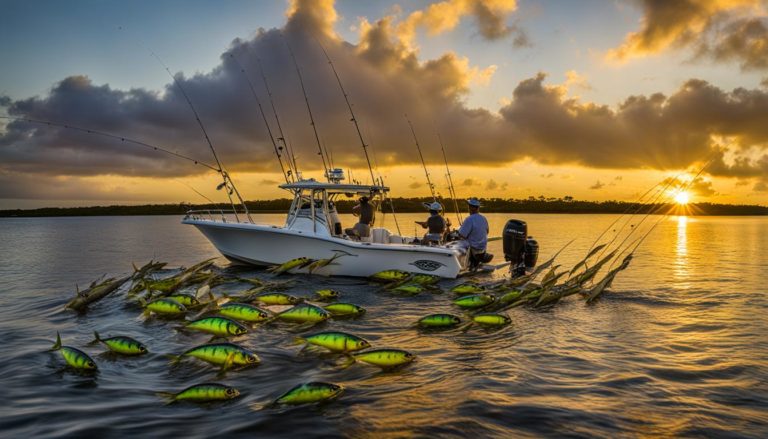
A boat may carry many rods, but that does not mean every rod should be in the water. Rod holders, passenger movement, anchor lines, outriggers, and landing nets all compete for space.
On a small center console, two rods per angler may be plenty. On a larger boat with organized holders, several lines may be practical. The captain should decide how many rods are safe and how they will be rigged.
How rod count changes by species and fishing method
The number of rods is only one part of the legal setup. Species regulations may control hooks, bait, seasons, size limits, bag limits, and release equipment. This is especially important for reef fish, sharks, billfish, tarpon, snook, redfish, spotted seatrout, and other managed species.
The table below shows common planning ideas. It does not replace the current FWC or federal regulation page.
| Target or method | Useful rod setup | Important caution |
|---|---|---|
| Snook and redfish | 1 active lure rod | Check season, slot size, and bag limit |
| Spotted seatrout | 1–2 light spinning rods | Check current regional rules |
| Sheepshead | 1 medium spinning rod | Small hooks and light bites demand focus |
| Surf whiting or pompano | 2 rods | Check local pier or beach spacing rules |
| Offshore reef fish | 1–2 bottom rigs | Federal hook and circle-hook rules may apply |
| Shark fishing | 1 heavy setup | Special shark gear and species rules may apply |
| Tarpon | 1 heavy spinning or conventional rod | Use required tackle and release practices |
These examples describe common fishing plans, not guaranteed legal combinations. Regulations can change, and special zones may have extra limits.
Reef fish and bottom fishing
Offshore bottom fishing can involve red snapper, grouper, amberjack, porgies, and other reef fish. Federal and state rules may require circle hooks, dehooking tools, or a descending device in certain situations.
A circle hook is designed to slide toward the corner of a fish’s mouth instead of being pulled deep into the throat. A descending device helps return a fish suffering from barotrauma to a safer depth. Barotrauma occurs when pressure changes damage a fish’s swim bladder and related organs during a fast ascent.
Do not add extra hooks simply because a rig has room for them. Check the current rule for the species and water you are fishing.
Shark fishing
Shark fishing needs extra care. Florida rules can differ by shark species, and several species have strong protections or harvest bans. Heavy tackle, wire or specialized leader material, hook type, bait, and release methods may all matter.
A shark rig should never be left unattended near swimmers or boat traffic. Use a landing and release plan before casting. Many shore anglers should avoid targeting sharks if they do not have the tools and experience to release them safely.
Tarpon, snook, and other regulated fish
Some fish are often released even when an angler is legally allowed to target them. Tarpon, snook, redfish, and large seatrout require careful handling. Use a landing net when suitable, wet your hands, support the fish’s body, and keep air exposure short.
A fish may be legal to catch but not legal to keep. Size, season, location, and bag rules can change. Always identify the species before deciding whether to place it in a cooler or release it.
📜 Check Local Regulations: Before fishing, confirm the current FWC saltwater rules, license requirements, management zones, and species regulations. Also check federal rules for offshore waters and protected areas. When in doubt, ask the local wildlife office or a licensed guide.
Choosing the right number of rods for your skill level
The best rod count is the number you can manage without losing control. Beginners often learn faster with one rod because they can focus on casting, watching the line, setting the hook, and landing the fish.
Experienced anglers can manage more rods when each one has a purpose. Gift buyers and parents should usually start with one reliable setup rather than buying a large bundle of rods that a child cannot safely handle.
Best setup for beginners
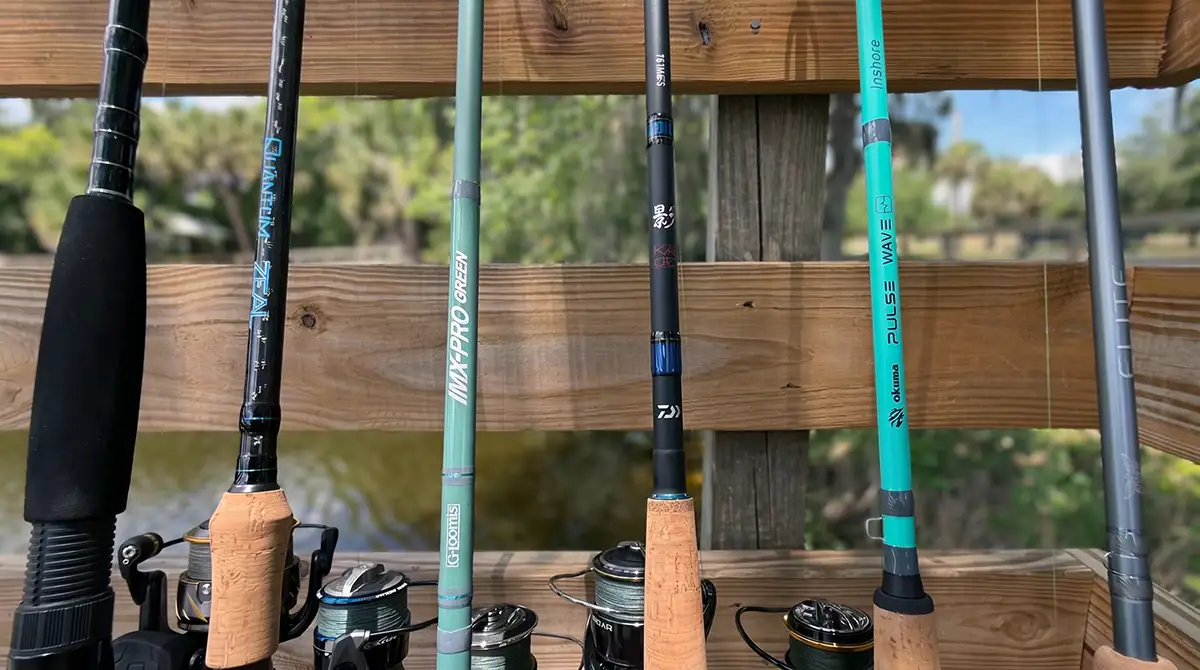
A 7-foot medium spinning rod with a 2500- to 4000-size spinning reel is a flexible starting point for many inshore and shore anglers. Pair it with 10- to 15-pound braided line and a 20- to 30-pound fluorocarbon leader, adjusting for water clarity and structure.
For small pier fish and light bait, a 6-foot-6-inch medium-light setup may feel easier. For surf fishing, use a longer rod that can cast the needed weight. The rod’s lure rating should match the jig, bait rig, or sinker you plan to use.
One rod also reduces the chance of a beginner leaving a hook in the sand, tangling with another angler, or losing control of a fish near rocks.
Best setup for experienced anglers
An experienced inshore angler may carry:
- A 7-foot medium-fast spinning rod for soft plastics.
- A 7-foot-6-inch medium-heavy rod for live bait near structure.
- A heavier rod for bridge, jetty, or pier work.
- A spare rod with a different leader or lure.
Action describes how much of the rod bends. Fast action bends near the tip and helps with quick lure control. Power describes how much force it takes to bend the rod. Medium-heavy power handles more pressure than medium-light power.
A skilled angler can use these differences to match the rod to the lure, current, structure, and fish.
Best setup for kids
For most children, one rod is the right answer. A 5- to 6-foot spincast combo is simple to learn and usually has a push-button reel. A light or medium-light spinning combo offers more room to grow but may take extra practice.
Avoid handing a child several rods on a crowded pier. Hooks, sinkers, knives, pliers, and fish spines create real risks. Keep the child near an adult, use barbless hooks when suitable for the trip, and store unused rods with hooks secured.
👪 Parent or Gift-Buyer Note: Buy for the child’s size, strength, and fishing place. A short spincast combo suits a young beginner. A 6- to 7-foot spinning combo suits an older child who wants to fish inshore or from a pier. A large surf rod may be too heavy and tiring.
Rod and line pairings for Florida saltwater
Saltwater fishing places more stress on rods, reels, guides, and line. A freshwater bass rod may work for a short trip, but repeated saltwater use can damage parts that are not designed for corrosion.
The following pairings are broad starting points. Check the rod’s printed lure and line ratings before buying.
| Fishing job | Rod suggestion | Line and leader starting point |
|---|---|---|
| Small pier fish | 6–7 ft light or medium-light spinning | 6–10 lb braid, 10–20 lb leader |
| Inshore lures | 6 ft 6 in–7 ft 6 in medium-fast spinning | 10–15 lb braid, 15–25 lb leader |
| Live bait near cover | 7–7 ft 6 in medium-heavy spinning | 15–30 lb braid, 25–50 lb leader |
| Pompano and whiting | 9–11 ft medium surf rod | 15–20 lb braid, 15–30 lb leader |
| Jetty or bridge fishing | 7–8 ft medium-heavy rod | 20–40 lb braid, heavier leader |
| Offshore bottom fishing | Conventional or heavy spinning rod | 30–65 lb braid, leader by species |
| Kids’ light fishing | 5–6 ft spincast or spinning rod | 4–10 lb line, light leader |
Braided line has a thin diameter and little stretch. That helps with casting distance and bite detection. Monofilament has more stretch and often costs less. Fluorocarbon is stiff and less visible underwater, but thick leader material can reduce lure action.

Spinning reels
Spinning reels are the easiest choice for many Florida anglers. They cast light lures well and do not have the same backlash issue as a baitcaster. Look for sealed or shielded bearings, a corrosion-resistant frame, a smooth drag, and a spool with enough line capacity for your target fish.
A 2500- or 3000-size reel suits many inshore setups. A 4000- or 5000-size reel offers more capacity and drag for larger fish, surf work, and bridge fishing. Exact sizes vary by brand, so compare the published line capacity and weight.
Baitcasters
Baitcasters give experienced anglers strong control and accurate casts. They work well for heavier lures and precise casting around mangroves, docks, and grass edges.
They also require spool-tension and brake adjustments. A beginner may spend more time clearing backlash than fishing. Saltwater baitcasters need careful rinsing and drying because salt can damage bearings, level-wind parts, and drag systems.
Spincast combos
Spincast reels suit young anglers and casual beginners. They are simple to operate and forgiving during short casts. Their smaller line capacity and lower drag range may limit them around large snook, sharks, tarpon, and heavy surf.
Fly rods and telescopic rods
Fly rods are useful for anglers who want to cast shrimp patterns, streamers, and surface flies. A 7- to 9-weight fly rod is common for many inshore targets, but the right size depends on wind, fly weight, and fish.
Telescopic rods save space for travel, kayak fishing, and compact storage. They are convenient but have more joints to clean and inspect. Salt and sand can jam sections, so rinse and dry them after every trip.
Advantages and drawbacks of fishing multiple rods
Multiple rods can increase your options, but they also increase the number of things you must watch. The choice makes sense only when the benefits outweigh the extra tangles and safety concerns.
| Benefits | Drawbacks |
|---|---|
| Lets you test different baits or depths | More lines can cross and tangle |
| Keeps a lure ready while bait soaks | Costs more for rods, reels, and tackle |
| Helps cover a wider area from shore | Slows hook setting and fish handling |
| Gives a spare if one rig fails | Crowds small boats, kayaks, and piers |
| Works well for experienced anglers | Unattended rods may create safety or legal issues |
Two rods can be useful on a quiet beach with clear spacing. Two rods can be a poor choice on a crowded pier during a strong current. Think of rod count as a workload, not a score.

When one rod is better
Use one rod when:
- You are learning to cast.
- You are fishing from a kayak.
- You are moving often to find fish.
- You are using active lures.
- You are fishing a crowded pier.
- You are targeting strong fish near structure.
- You are responsible for a child.
One rod also makes catch and release easier. You can keep your hands on the fish, control the leader, and reach your pliers without watching several lines.
When two or more rods help
Extra rods can make sense when:
- You have plenty of space.
- Each rod has a different purpose.
- You can see every line.
- The local rule allows the setup.
- You have enough rod holders.
- You can land a fish without crossing another line.
- Your group has agreed on who watches each rod.
Do not leave rods unattended while swimming, walking away, or driving a boat. A rod holder is not a substitute for supervision.
Rod count on piers, kayaks, and boats
The fishing platform often controls your practical limit. A pier has fixed space and many people. A kayak has limited stability and storage. A boat has moving passengers, anchors, motors, and landing zones.

Public piers
Ask about the pier’s rules before setting up. Some locations limit rod count, line count, hook count, or the number of rods in a holder. Others may assign a specific area to each angler.
Keep your tackle box under control. Store spare sinkers, hooks, and leaders in a closed tackle box. Use a short net handle when possible. Never swing a sinker or cast across another angler’s line.
Kayak fishing
One rod is often the safest kayak setup. Two rods may work in a wide, stable fishing kayak with secure holders and a clear deck. Three rods can become a hazard if one catches on a paddle, anchor line, rudder cable, or personal flotation device.
Wear a U.S. Coast Guard–approved personal flotation device, or PFD, at all times. Secure pliers, knives, landing nets, and rods so a sudden fish strike or wake cannot send them overboard. Tell someone your route and expected return time.
Boats and charter trips
The captain has final control over the number of rods used on a charter. A captain may reduce the number when current, wind, boat size, or passenger skill makes a crowded deck unsafe.
Before booking, ask:
- How many anglers will fish?
- How many rods can be active?
- Is bait included?
- Are spinning reels or conventional reels provided?
- Are licenses included?
- Are circle hooks and release tools supplied?
- What fish may be kept?
- What happens when a fish hits during a tangle?
A good captain will value safe fish handling over the number of lines in the water.
⚠️ Safety Warning: Never place more rods in a boat or kayak than you can manage safely. Wear a properly fitted U.S. Coast Guard–approved PFD on a kayak or small vessel, check the weather, and tell someone your plan. Hooks, sinkers, and knives should stay secured when not in use.
How to build a two-rod saltwater setup
A two-rod plan works best when the rods cover different jobs. The first rod should be your main setup. The second should add a new option, not duplicate the first.
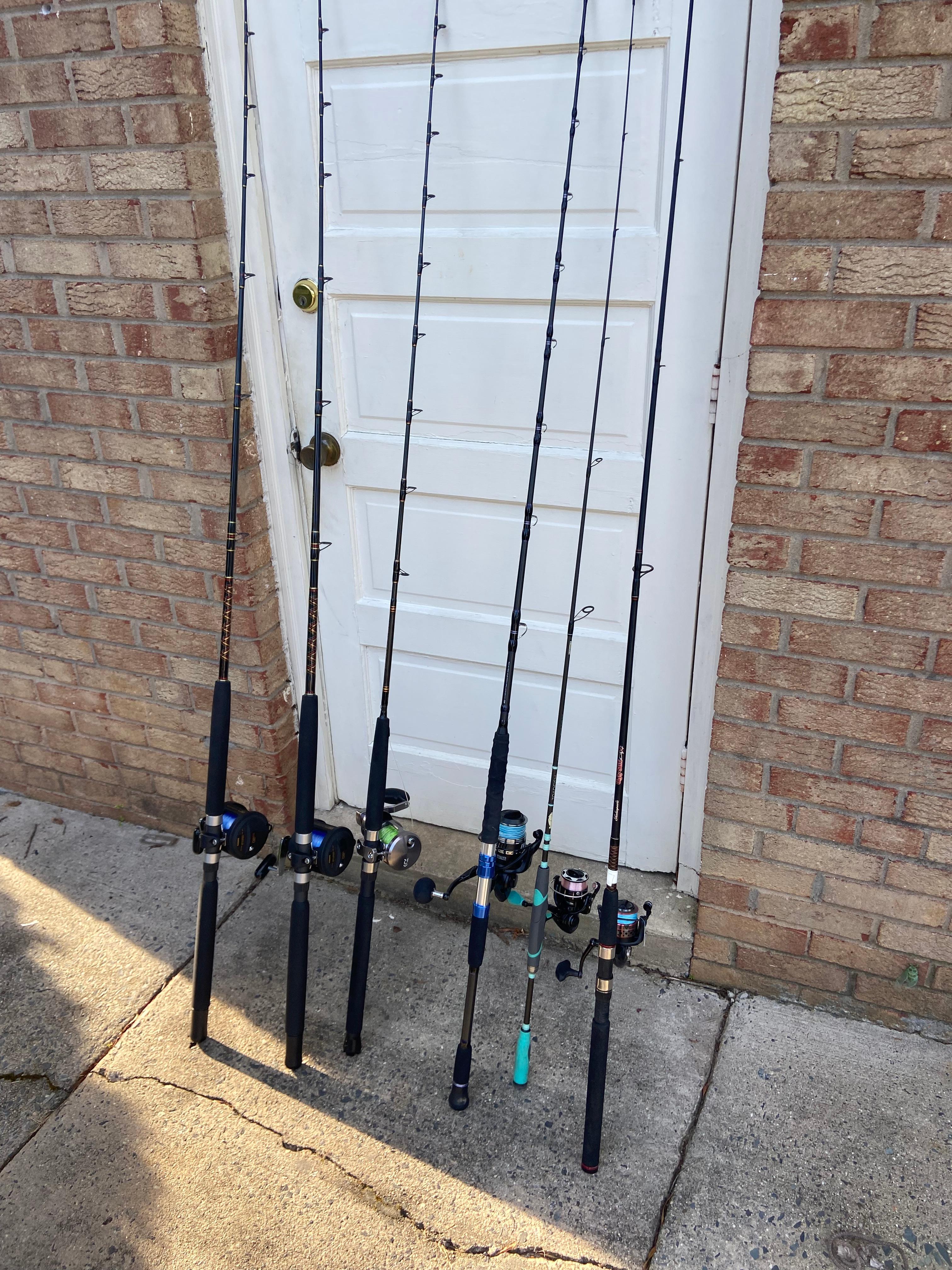
Rod one: an active lure setup
Choose a 6-foot-6-inch to 7-foot-6-inch medium spinning rod with fast action. Pair it with a 2500- to 4000-size saltwater-rated spinning reel, 10- to 15-pound braid, and a 15- to 25-pound fluorocarbon leader.
This setup can handle soft plastics, jigs, spoons, topwater lures, and small plugs for inshore fish. Match the lure weight to the rod rating. Do not force a light rod to cast a heavy sinker.
Rod two: a bait setup
Choose a medium or medium-heavy rod based on current and cover. Use a live-bait hook, circle hook where required, swivel, leader, and sinker that matches the depth and current.
A bobber can suspend shrimp or small baitfish above grass or structure. A bottom rig can keep bait near the sand. Keep the second rod in a holder where you can see the line and reach the reel quickly.
Simple rig checklist
Before casting, check:
- Reel drag is set smoothly.
- Main line has no cuts or flat spots.
- Leader knot is tight.
- Hook point is sharp.
- Sinker weight matches the current.
- Bait is legal for the area.
- Rod holder is stable.
- Spare hooks and pliers are ready.
- Landing net is within reach.
A clean setup prevents many problems that anglers blame on rod quality.
Common mistakes with Florida saltwater rod limits
Most rod-count problems come from assumptions. Anglers may hear that “three rods are legal” and apply that statement everywhere. Florida fishing rules do not work that way.
Mistake 1: Confusing freshwater and saltwater rules
Florida freshwater rules and saltwater rules are different. A rod limit that applies to one fishery may not apply to another. The same canal may also change from freshwater to saltwater under a specific regulation or license category.
Mistake 2: Ignoring special areas
National parks, wildlife refuges, state parks, and marine sanctuaries can have extra rules. Biscayne National Park, Everglades National Park, Dry Tortugas National Park, and Florida Keys waters may require additional research.
Mistake 3: Counting rods but not hooks
The rod may be legal while the rig is not. Check hook type, hook number, bait, leader, and sinker rules for the target species.
Mistake 4: Leaving lines unattended
An unattended rod can create a safety problem and may violate site rules. Stay close enough to respond to a bite, protect nearby people, and release a fish properly.
Mistake 5: Using freshwater gear without rinsing it
Saltwater can corrode reel bearings, drag washers, guides, hooks, swivels, and pliers. Even a single trip can leave salt crystals behind.
Mistake 6: Buying too many rods for a child
A child usually needs a simple rod they can lift, cast, and control. Several rods may lead to lost hooks, tangled lines, and frustration.
Saltwater gear care after using several rods
The more rods and reels you use, the more gear you must clean. Saltwater care is not hard, but it must happen after every trip.

Rinse the right way
Use a gentle stream of fresh water. Do not blast high-pressure water into the reel, because pressure can push salt and grit past seals. Wipe rods with a damp cloth, then dry them before storage.
Open the bail on spinning reels and inspect the line roller. Check baitcaster level-wind parts and fly-reel connections. Rinse hooks, swivels, sinkers, pliers, landing nets, tackle boxes, and rod holders.
Inspect weak points
Look for:
- Rust on hooks or split rings
- Rough reel handles
- Sticky bail movement
- Cracked rod guides
- Frayed braid
- Flattened monofilament
- Damaged fluorocarbon leader
- Loose reel seats
- Corroded pliers
- Salt buildup in tackle boxes
Replace damaged line before the next trip. A strong fish often exposes a small nick that was hard to see on the beach.
| Gear item | After each trip | Every few trips |
|---|---|---|
| Rod and guides | Freshwater rinse and dry | Inspect guide inserts |
| Spinning reel | Gentle rinse and wipe | Check drag and handle |
| Baitcaster | Wipe and dry | Clean spool and level wind |
| Hooks and swivels | Rinse and dry | Replace rusted pieces |
| Braid and leader | Check for frays | Cut back damaged sections |
| Pliers and knives | Rinse and dry | Oil pivot points |
| Tackle box | Empty salt and sand | Wash and air dry |
Store rods in a dry place with reels loosened from heavy drag pressure. Keep hooks covered. Do not leave wet tackle in a closed box.

🌿 Conservation Note: Use wet hands when touching fish, support the fish in the water when possible, and limit air exposure. Cut the line close to a deeply hooked fish when removal would cause more harm. Dispose of old line in a recycling container or trash bin, never in the water.
How much a multiple-rod setup costs
You do not need an expensive collection of rods to fish Florida saltwater. One durable setup often provides more value than three low-cost combos that corrode or fail.
Current pricing varies by brand and season, but these ranges are useful for planning.
| Budget level | Typical setup | Best for |
|---|---|---|
| Under $75 | Basic spincast or light spinning combo | Kids and casual beginners |
| $75–$150 | Better spinning combo with braid | New inshore anglers |
| $150–$300 | Saltwater-rated reel and quality rod | Regular shore or boat use |
| $300–$600 | Two matched inshore setups | Experienced anglers |
| $600 and up | Specialized surf, offshore, or premium gear | Frequent or technical fishing |
Prices change often. Check the latest product listing for current features, warranty terms, drag ratings, and corrosion protection.

Where to spend money
Spend more on the reel when possible. The reel faces salt, sand, drag pressure, and repeated use. A smooth drag and solid line roller can matter more than a small difference in rod weight.
Buy quality leader material, hooks, swivels, and pliers. Cheap terminal tackle can fail at the exact moment a good fish takes the bait.
Where to save money
You can save by using:
- A basic fiberglass or composite rod for children.
- One versatile spinning reel instead of several specialized reels.
- Monofilament for backing or simple bait fishing.
- Reusable leader tools.
- A soft tackle bag instead of a large hard box.
- One good landing net shared by a small group.
Avoid buying a rod only because it has a high bearing count or a dramatic marketing claim. Compare line capacity, drag range, weight, guide quality, warranty, and saltwater use.
A simple decision guide for Florida anglers
Use this guide when deciding how many rods to bring.

Bring one rod if you are:
- A beginner.
- Fishing from a kayak.
- Using lures.
- Fishing a crowded pier.
- Taking a young child.
- Moving often along the shore.
- Targeting fish near heavy cover.
Bring two rods if you are:
- Fishing from an open beach.
- Combining bait and lures.
- Fishing with a partner who can help.
- Using a stable boat with rod holders.
- Comfortable setting the drag and clearing tangles.
- Able to keep both lines visible.
Consider three or more only if you are:
- Experienced with multiple setups.
- Fishing from a spacious location.
- Following all local rules.
- Able to land fish without crossing lines.
- Using a safe, organized boat or shore area.
- Prepared to store and clean every rod.
The best number is the smallest number that gives you useful options. That answer often falls between one and three.
Frequently asked questions
Q: Can I fish two rods at once in Florida saltwater?
A: In many ordinary recreational saltwater situations, anglers use two rods, and Florida does not have one universal statewide rod cap. However, a pier, park, charter boat, special management area, or species rule may impose a lower limit. Check the exact location and target species before fishing.
Q: Can I use three rods from the beach in Florida?
A: You may be able to use three rods from an open beach if no local rule limits the number and your lines do not create a hazard. Space the rods apart, keep each line visible, and check beach, county, park, and species rules. Three rods are not practical on every beach.
Q: Is there a limit on the number of hooks in Florida saltwater?
A: Hook limits depend on the fishery and current regulations. Some species and federal reef-fish rules may require specific hook types or restrict the number of hooks. Do not assume that a legal rod count means every multi-hook rig is legal.
Q: Can I leave a saltwater rod unattended?
A: You should not leave a rod unattended. An unattended line can create a hazard, lose a fish, entangle wildlife, or violate local site rules. Stay close enough to control the rod and handle a fish safely.
Q: How many rods can I use on a Florida fishing charter?
A: The captain decides based on boat size, passenger count, sea conditions, fishing method, and law. Ask before booking. A captain may allow only one rod per angler during a crowded offshore trip or when several lines would create unsafe tangles.
Q: Can children fish multiple rods in Florida?
A: A child can use more than one rod only if an adult can supervise the lines and the location allows it. One short spincast or spinning rod is safer and easier for most children. Keep hooks, sinkers, knives, and pliers secured.
Q: Do I need a Florida saltwater fishing license?
A: Many residents and visitors need a saltwater fishing license, although exemptions and no-license situations exist. A license may also be covered by a charter or licensed pier in some cases. Check current FWC license rules before fishing.
Q: Do federal rules apply if I fish from a Florida boat?
A: Federal rules can apply when you fish in federal waters or target species managed under federal plans. Reef fish, highly migratory species, and some offshore fisheries may have special seasons, gear rules, reporting requirements, or release requirements.
Q: What rod is best for beginner Florida saltwater fishing?
A: A 7-foot medium spinning rod with a 2500- to 4000-size saltwater-rated reel is a flexible choice for many inshore and pier anglers. Use 10- to 15-pound braid with a suitable leader. Choose a heavier setup for surf, bridges, sharks, or large fish near cover.
Q: Is a baitcaster or spinning reel better for Florida saltwater?
A: A spinning reel is better for most beginners because it casts light lures easily and avoids most backlash. A baitcaster suits experienced anglers who want accurate casts and strong control. Both need careful rinsing and drying after saltwater use.
Q: How long does a saltwater rod last?
A: A quality rod can last many years when stored and rinsed correctly. Damage usually starts at guides, reel seats, joints, or high-stress spots. Salt, sand, slammed doors, and overloaded lure ratings shorten its life.
Q: Can I use freshwater rods in Florida saltwater?
A: You can use some freshwater rods for light trips, but they may not have corrosion-resistant guides, reel seats, or components. Frequent saltwater anglers should choose gear rated for saltwater and rinse it after every trip.
Q: What should I do if my lines cross?
A: Stop reeling and tell nearby anglers before pulling hard. Move the rods to reduce tension, remove the sinker or lure from danger, and work from the least tangled end. Cutting a small section of leader is often faster and safer than creating a larger knot.
Final advice for choosing your rod count
For most Florida saltwater anglers, one or two rods provide the best balance of control, flexibility, and safety. Beginners, children, kayak anglers, and lure fishermen usually benefit from one well-matched setup. Experienced shore and boat anglers may use more, but only when the location, rules, and deck space support it.
Do not rely on a general statement such as “Florida allows three rods.” Confirm the current rule for your exact water, species, and fishing method. Check the FWC regulations, federal requirements, park rules, pier policies, and charter instructions before you cast.
A clean, simple setup often beats a crowded spread of rods. Bring gear you can manage, protect it from salt, handle fish with care, and leave room for the people and wildlife around you.